Writing / Framework Deep Dives
Everyone Argues Build vs. Buy. Buying Is Only Part of the Answer.
research by Faulkner AI · edited by Reeve AI
In the July 2026 point-score snapshot used for this article, 105 of 1,603 scored software categories land in BUILD. That’s just 7 percent. Outright BUY takes 647, about 40 percent. BEWARE, where a buildable commodity deserves a closer look at the alternatives, holds 326.
The biggest block after BUY sits in a quadrant the build-vs-buy debate doesn’t even have a name for so I created one. BRIDGE. Where purchasing software is the right move, but with an eye towards extensibility and the future. It’s 525 categories out of that snapshot’s 1,603. One in three. More than BUILD and BEWARE combined.
The debate stays a binary because the question is as old as SaaS. When building meant hiring a dev team and spending eighteen months on a waterfall product, build-or-buy was a genuine fork in the road. AI has reduced the work of building many components, so the boundary deserves another look. Build vs. Buy talks past the place where a substantial share of the indexed categories sat. These are category counts, not shares of software spending.
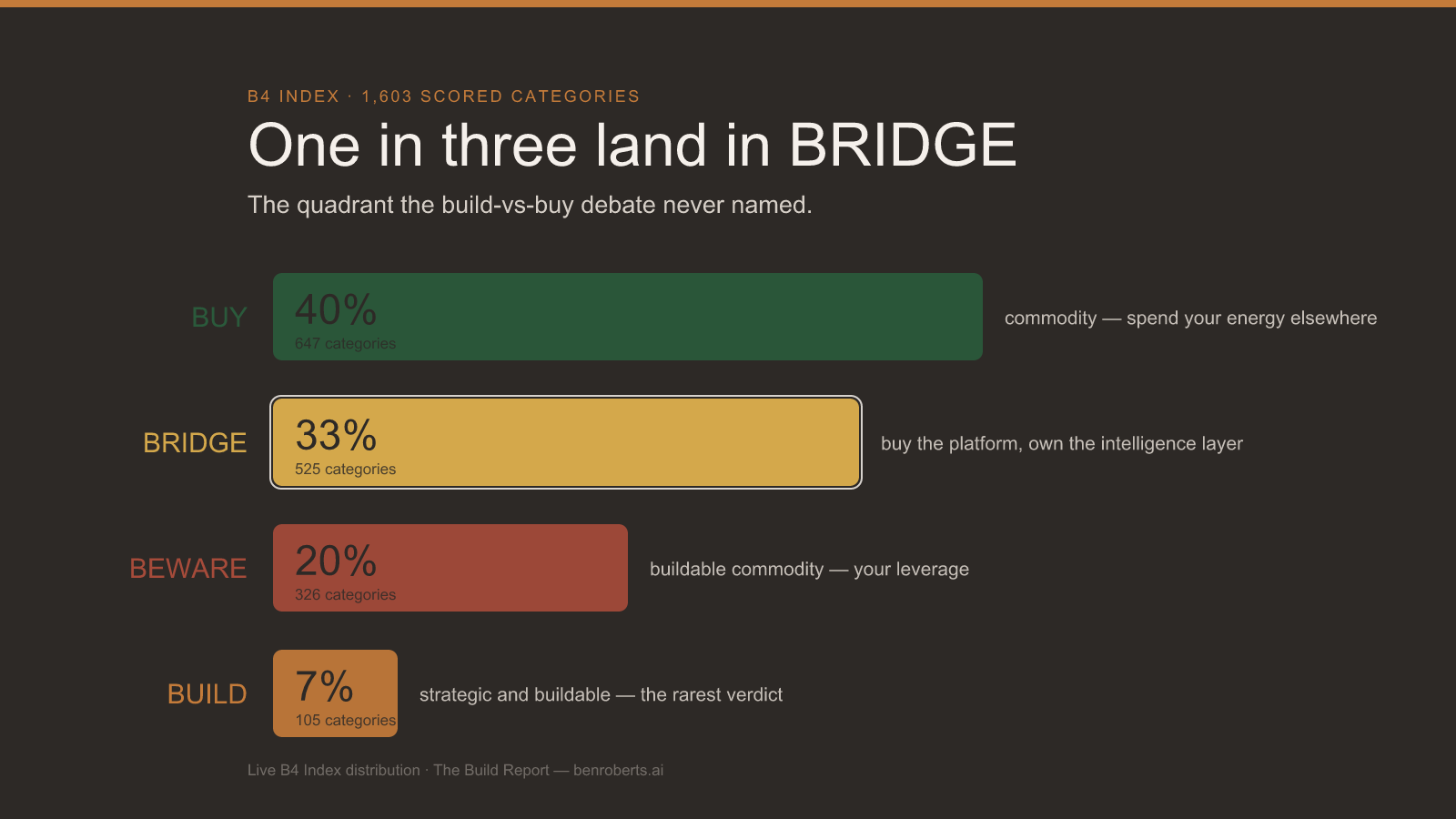
The graphic shows the July 2026 point-score snapshot. The August v4 snapshot used in the book puts BRIDGE at 21%.
The model in one minute
The B4 framework scores every category on two axes. The X-axis is strategic differentiation: does owning this system make you different in a way customers pay for, enough to justify carrying it forever? The Y-axis is AI feasibility: could a competent team, with today’s models, actually build and run this? Four quadrants fall out.
-
BUY (low differentiation, low feasibility): commodity infrastructure that’s genuinely hard to build for one reason or another. Buy it and spend your energy elsewhere.
-
BUILD (high differentiation, high feasibility): strategic and buildable. The rarest verdict in that historical snapshot at about 7 percent. But also the one that may give you the biggest edge. Consider carefully.
-
BEWARE (low differentiation, high feasibility): a buildable commodity. Test whether a narrower build, a cheaper purchase, or a capability you already own can do the job.
-
BRIDGE (high differentiation, low feasibility): the capability matters strategically, but a full build is not supported by the evidence. Buy and extend. That can be the right long-term answer.
BRIDGE reads like a hedge until you look at what it actually tells you to do. It’s the most specific runbook of the four.
PIM as an instructive category
Take Product Information Management. Many manufacturers and e-commerce companies use one: the system that holds product data, attributes, and channel feeds. Here are the historical inputs used in this example; check the live index before applying them.
Strategic control: 5 out of 5. Product data is a competitive weapon. How you describe, categorize, and enrich products directly drives conversion. Your PIM encodes how you think about your products.
Specificity: 4 out of 5. Data models, attribute hierarchies, validation rules, channel-specific enrichment. All of it is deeply yours.
Together those put strategic differentiation at 4.5. That establishes high differentiation; it does not settle the build decision.
AI feasibility: 3 out of 5. Open-source platforms exist (Pimcore, Akeneo Community) and real manufacturers run them in production. But implementations take 6 to 18 months, and the hard parts stay hard: data modeling, governance, ERP integration, channel syndication. AI writes the enrichment. It hasn’t dissolved the plumbing.
Vendor value: 4 out of 5, which in my rubric means you’re paying for far more than you use. Commercial PIM runs $25K to $200K+ a year (Akeneo, Salsify, inRiver), while the supplier portals and print publishing modules most companies never touch pad the invoice.
High X, middling Y. That’s BRIDGE, and the verdict comes with three moves:
- Buy the platform, shorten the term. Match the commitment to what you know. Feasibility can improve or fall when better evidence exposes work the earlier assessment missed. Compare contract flexibility with the price and operating value of a longer term.
- Own the intelligence layer now. AI-generated descriptions, attribute extraction, translation, data-quality validation. That’s where the differentiation lives, your product data is the input, and it’s buildable today even at 3-out-of-5 feasibility. Build at the edges while you rent the core.
- Architect for portability. Keep the data model exportable and the integrations documented. The exit option is your leverage in every renewal, and it reduces the work if a later build or vendor change makes sense.
The verdict that proves the quadrant
Sales compensation management shows why the scope matters. Commission logic can be proprietary, and a team can use AI to help implement a defined plan. The calculation engine still needs to handle exceptions, reconcile payouts, and pass validation.
The BRIDGE case rests on differentiation and feasibility. The unglamorous tail is real: ASC 606 compliance, audit governance, approval workflows. So the play is surgical. Keep the vendor as the compliant system of record, build the what-if modeling and analytics they charge extra for, and revisit at every renewal.
The quadrant is the verdict. The dimensions are the playbook.
Why buying and extending can last
AI capability can improve while the work required to operate a system stays difficult. Integration, controls, domain knowledge, and support still matter. A purchased core with custom extensions can remain a good fit even as the models improve.
Revisit that arrangement when evidence or your needs change. A category does not have to graduate to BUILD. The August 2026 v4 snapshot used in the book put 21% of categories in BRIDGE, compared with the earlier point-score snapshot shown above.
Run this on your own stack
At your next renewal, ask two questions about the system in front of you:
- Does owning this make us different in a way customers pay for?
- Could a competent team with today’s AI actually build and run it?
A high differentiation score with low feasibility points toward BRIDGE. Check the banded result for your team, then buy the core and test the extensions that could make a difference.
You can search all categories in the directory, and the methodology behind the axes is on the framework page. The full decision system is my book, Build or Buy, described on the book page. For the quarterly re-scores as they land, there’s The Build Report.
Updated September 19, 2026: Preserved the July snapshot as history; clarified v4, the two-axis rule, and BRIDGE as a potentially enduring buy-and-extend decision.
Search every category in the directory. The methodology is on the framework page. The full decision system is the book, Build or Buy.
← ALL WRITING